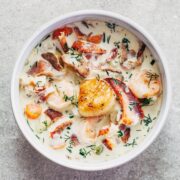
Nova Scotia Seafood Chowder
This Nova Scotia seafood chowder recipe is loaded with seafood, bacon, fresh dill, and cream, and has been carefully tested over many years.
Servings: 8 servings
Calories: 550kcal
Equipment
- Paper towel
- Slotted spoon optional
- Tongs
- 6 quart (6L) pot cast iron or other heavy bottomed pot
- Measuring cups and spoons or digital kitchen scale
- Liquid measuring cup
- Sturdy spoon or spatula
Ingredients
- 12 large sea scallops fresh or thawed from frozen
- 3 strips thick-cut bacon or 6 regular strips, chopped
- 4 cups water
- 2 large potatoes washed and unpeeled, chopped into ½ inch (1.5 cm) pieces
- 2 large carrots washed and unpeeled, sliced into ¼ inch (6 mm) coins
- 1 teaspoon salt
- 3 cups 35% cream also called whipping cream
- 1 cup cooked lobster chopped
- 1 cup raw haddock fresh or thawed from frozen, cut into bite-sized pieces
- 18 large raw shrimp fresh or thawed from frozen, peeled, deveined, chopped
- 2 tablespoons fresh chives chopped
- 2 tablespoons fresh dill finely chopped
- ¼ teaspoon ground black pepper freshly cracked
Instructions
- Dry the scallops well by sandwiching them gently between sheets of paper towel, then set aside. The drier the surface of the scallops, the more golden the sear should be.
- Cook the bacon in a large heavy-bottomed pot over medium-high heat until almost crisp, then use a slotted spoon to transfer it to a plate lined with paper towel and set aside.
- Keep the bacon grease hot over medium-high heat. Use tongs to gently place the scallops in the hot fat, and cook until golden, about 2 to 3 minutes per side. Remove the scallops from the pot and set aside.
- Add the water, potatoes, carrots, and salt to the pot, then use a wooden spoon to scrape up any stuck-on bits from the bottom. Bring to a boil, reduce the heat to medium-low, partially cover with the lid, and gently simmer until the vegetables are tender, about 12 to 15 minutes.
- Pour the cream into the pot, bring the chowder back to a simmer, and continue to cook for 10 minutes.
- Gently stir the cooked lobster, raw haddock, and raw shrimp into the pot. Simmer gently for 5 minutes until the seafood is just cooked through.
- Add the cooked bacon, chives, dill, and pepper, then adjust the seasoning to suit your taste. Ladle the chowder into bowls, making sure each serving gets a fair share of seafood, then top with pan-seared scallops and a sprinkle of fresh chopped dill. Serve hot with fresh rolls or biscuits.
Notes
- For detailed ingredient notes, substitution tips, variations, and step-by-step photos, scroll through the full recipe post.
- Use a digital kitchen scale for precise measurements.
- To switch to gram measurements, click “Metric grams” in the ingredients section of the recipe card.
- If using frozen seafood, thaw it completely in the fridge and pat it dry before cooking to avoid excess water in the pot.
- Cook only as many scallops as you plan to serve, since they are best enjoyed fresh from the pan. I prefer the look and taste of pan-seared scallops, but you can add them directly to the pot when you add the other seafood if you want.
- After adding the seafood, stir gently, especially since white fish like haddock tends to flake apart easily.
- Seafood chowder tastes better on the second day. I'd even argue it tastes best on the third day.
Storage
- Store leftover seafood chowder in a plastic or glass container with a tight-fitting lid in the refrigerator for up to three days. Reheat gently in a small pot over medium-low heat or in the microwave at half power until hot and steamy, stirring once or twice.
- I do not recommend freezing seafood chowder.
Nutrition
Serving: 1serving | Calories: 550kcal | Carbohydrates: 22g | Protein: 25g | Fat: 40g | Saturated Fat: 24g | Polyunsaturated Fat: 3g | Monounsaturated Fat: 11g | Trans Fat: 0.03g | Cholesterol: 211mg | Sodium: 937mg | Potassium: 836mg | Fiber: 3g | Sugar: 4g | Vitamin A: 4502IU | Vitamin C: 20mg | Calcium: 130mg | Iron: 1mg